
Meditation is absolutely for everyone (yes, even you).
By Kaelene Curry, VP of Coaching Development and Director of Mental Performance at Coya
Meditation has been practiced for over 5,000 years, by individuals (and entire cultures and communities) all over the world. Many recognize the practice as the heartbeat of their nervous system regulation; it keeps them grounded, helps them find their footing through any storm, and places them in the driver’s seat of their minds. And yet, despite the reputation that precedes it, meditation is also still fiercely misunderstood.
Many of us fall into the trap of filing meditation away as something for other people. Something we “just aren’t good at”, or that simply doesn’t work for us. We dismiss it as a rigid, intimidating framework that demands some kind of innate stillness or mental control we don’t possess. But that’s a complete misrepresentation of a practice that changed the lives of so many of our ancestors, and that continues to change lives all around us today.
Because there isn’t one, “right” way to meditate. The mind is a wholly subjective thing, and any practice that involves it will surely follow suit. There are methods and guidelines, sure, but the practice remains yours to explore, deconstruct, and reconstruct as your own.
More important than that, though, is the realization that meditation isn’t the absence of thoughts. It is not defined by an idyllic, “zen” state where your thoughts immediately clear, leaving nothing but peace and quiet in their wake.
If you sit down to meditate, with your eyes closed and your breathing slowed, and your mind immediately begins to drift… that isn’t a failure. Whatever self-conscious response you have in that moment – the sudden flare of realization, the determination that “you’re just not good” at this – I promise you, it doesn’t belong.
The wandering, the noticing, and the coming back isn’t the interruption of the practice. It is the practice. You didn’t fail the rep. You just did one.
The wrong scoreboard
People treat a sense of absolute calm as the cost of entry to meditation, rather than an occasional byproduct.
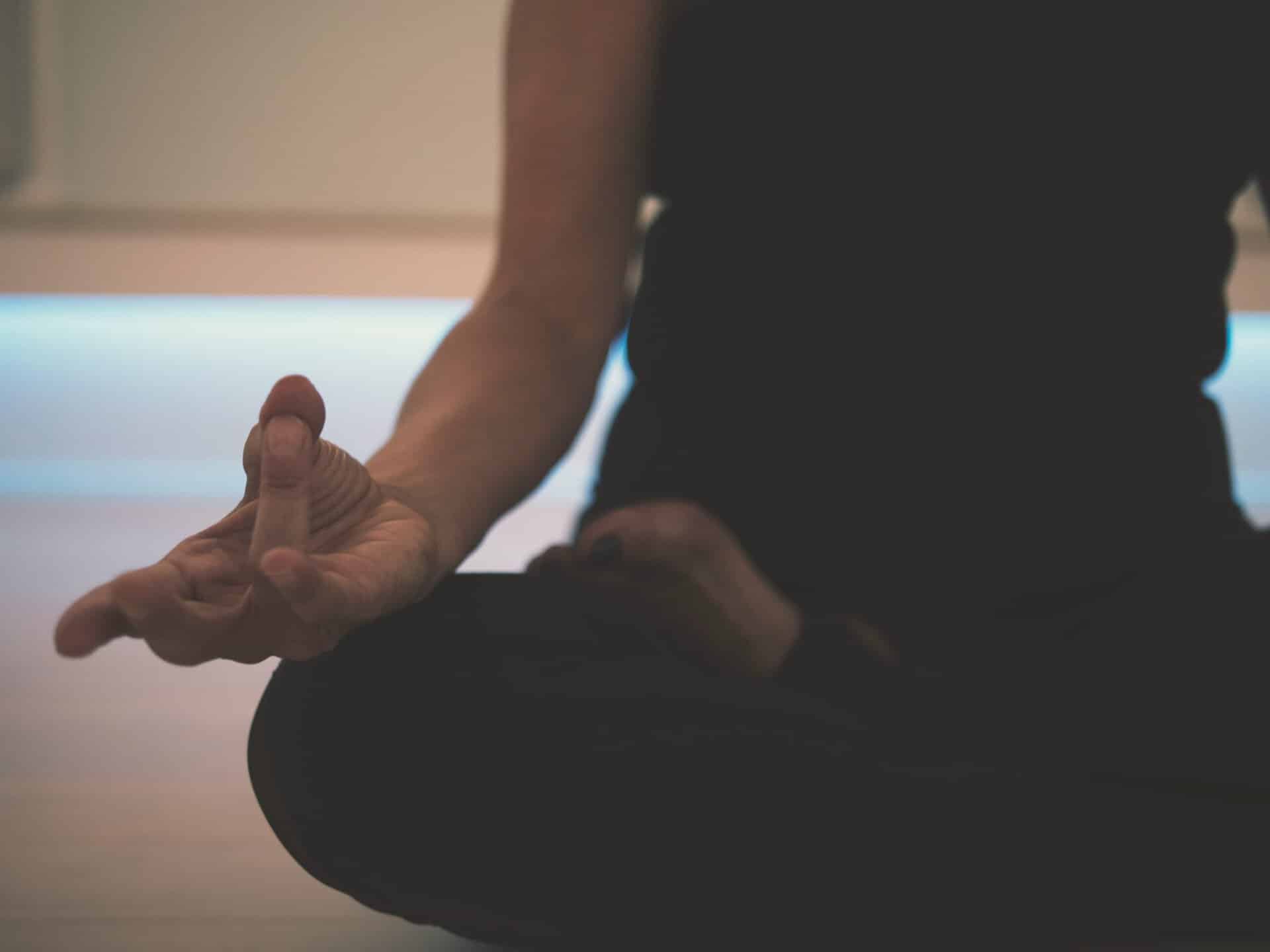
This is, without a doubt, one of the biggest misunderstandings I’ve run into in all my years working as a mindset coach. There’s a certain stereotypical visualization of meditation that involves a perfectly composed lotus position, a room that smells of sandalwood incense, and a serene half-smile plastered across your face.
So, we sit down with this picture in mind, and we set ourselves up for failure. Because when the mind does the very thing minds are built to do – generate thought – we interpret it as proof that we’re doing it wrong.
This barrier has less to do with faulty attention spans and far more to do with the scoreboard we assign to the practice. If you’re exclusively grading meditation by how empty you can make your head or how peaceful you feel when the timer goes off, you’re scoring the wrong game entirely.
The real entry point to meditation is the acceptance that it does not need to look a certain way, and that the desired outcome(s) you seek are on the other side of consistent practice – they aren’t the pre-requisite to doing it.
There’s a line from Sharon Salzberg (one of the teachers most responsible for bringing meditation into the secular Western mainstream) that perfectly dismantles the whole am-I-doing-this-right thought spiral. As she puts it, “We don’t meditate to get better at meditating; we meditate to get better at life.”
Read that, and then read it again. Because it’s the perfect advice for this category of mindset work.
If the goal were to become an elite meditator, then sure, a wandering or chaotic mind might warrant a questionable performance review. But the entire goal of meditation is to meet your mind exactly where it is. That doesn’t mean stamping down any uncooperative thoughts or emotions that rise to the surface. Avoidance and denial are entirely unhelpful in this context. Noticing any nagging thoughts and feelings, acknowledging them, and letting them pass is precisely what you’re there to do. And it’s this – not the absence of noise, but your relationship to it – that shapes your response to the other twenty-three hours and fifty-five minutes of your day, long after the meditation ends.
So if calm isn’t the point, what are you actually doing in there?
You’re turning the mind on itself. You’re spending a few minutes paying attention to your own mental machinery so you can actually take notice of how it runs. Just as never looking under the hood of your car is a bad way to become an expert on how it works, never examining your mind is a pretty sure way of remaining a passenger in it (rather than the driver).
Meditation is really just the practice of giving a little attention to what your mind is doing – the stories and scripts it hands you on any given day – so you can learn it. You start to notice the difference between what’s actually happening and the story you’re telling yourself about what’s happening. Because that gap between the event and your mind’s narration of it is where an enormous amount of our stress tends to live.
Meditation is the act of building a window where there was once a wall.
Reception versus reflection
I like to frame it as the difference between reception and reflection. Modern life is, quite literally, a near-constant assault of reception: notifications, pings, alerts, headlines, episodes, and messages. Our attention is currency, and we are constantly making transactions as our attention is effectively pulled in different directions throughout the day. So, whether we consciously realize it or not, most of us have a steady stream of input arriving faster than we can process it. We are almost never not receiving. And what we rarely do – what we often forget to carve out time and space for – is reflect.
Meditation is one of the few reliable reps of reflection we have left in an economy almost entirely engineered around reception. You are choosing, for a few minutes, to stop mindlessly taking inputs in and start looking at them, instead.
We are human beings, not human doings
Notice what happens when you meet someone new. After the name, the very next question (at least in American culture) is almost always the same: so, what do you do?
I would encourage you to try the reverse sometime. Describe yourself, or answer the “how are you?” question without mentioning your work or what you produce. For most people it’s genuinely hard, if not a little destabilizing, because somewhere along the way we started to conflate who we are with what we do. Our worth is too frequently defined by our output. But there is far more to life, our experiences, and our place in the world than that (or, at least, there should be).
Which is exactly why being – simply existing, unproductively, on purpose – can feel alien to some of us, or outright uncomfortable. Simply being has been so thoroughly coded as unproductive that most people feel a little guilty doing it. And so, the act of meditation can trip the same alarm as slacking off, even though it’s arguably one of the most useful things you can do.
I won’t pretend this resistance is easy to dismiss. The discomfort of stillness is real, and telling yourself it’s good for you doesn’t make the first few minutes any less squirm-inducing. But that discomfort is information, not a verdict. It’s the part of you that has been trained to equate motion with meaning, meeting a practice that asks for neither.
When we give ourselves time and permission to “just be” we’re practicing presence. A seminal study by Killingsworth showed that, on average, we spend only 53% of our time focused on what is in front of us. Meanwhile, 47% of our days, years, and lives are spent mind-wandering, inattentive, removed from our present experience. Feet on the ground, head in the clouds, so to speak. If I live to 100, I’d like to say I was actually present for more than just 53 of those years. “Being”, meditating, and practicing mindfulness are the tools to increase the amount of hours and years, thus moments and memories across your lifespan.
You don’t have to be good at it for it to work
And for the record, the benefits of meditation don’t appear to require that you be any “good” at it.
The Center for Healthy Minds at the University of Wisconsin–Madison built a free meditation app and studied what happens with genuinely minimal engagement. They found that roughly five minutes of meditation a day was associated with a 28% reduction in stress, a 24% reduction in symptoms of depression, an 18% reduction in anxiety, and a 13% increase in feelings of social connection. No silent retreat necessary. Just five minutes.
And the practice does more than shift how you feel. It also appears to reshape the tissue doing the feeling. In a well-known study out of Massachusetts General Hospital and Harvard, people brand new to meditation completed an eight-week mindfulness program, practicing an average of about 27 minutes a day. Afterward, brain imaging showed increased gray-matter density in the hippocampus, a region tied to learning, memory, and emotional regulation. The participants who reported the biggest drops in stress showed corresponding decreases in gray matter in the amygdala, the brain’s threat-detection center.
All this to say, our minds are meant to be trained, and meditation is not an inherent skill or talent. We know we have to introduce stimulus to build muscle; the more stimulus, the better the adaptation. Your mind is truly no different. We aren’t born “good” or “bad” meditators. We learn and practice the skill of mastering our mind – we have to physically do the reps – just like we would train for any other goal.
Change what you’re measuring
My best advice is this: stop holding your meditation practice to an impossible standard of perfect poise or zen-like calm. Instead, start counting the thing that actually builds the muscle: the return. Every time you notice you’ve drifted and come back, that’s a rep. A “bad” session with a hundred distractions and a hundred returns is, by this measure, a hundred reps, which actually makes it a pretty good session.
You don’t need the perfect set-up or the perfect conditions. If a pillow and an incense will help get you in the head space for it, go for it, but it’s absolutely not necessary to the practice. The only thing you actually need is five minutes and a willingness to begin, wander, notice, begin again. Find that loop, and repeat that loop, over and over again.
A few starting points, depending on what you’re working with:
If your mind is loud: Just start with your senses. Focus on what you can hear in your surroundings. Listening gives your attention a job to do while it settles in.
If even five minutes feels impossible: Start with one. Set a timer for 60 seconds, and focus on your breath. Count 6 slow inhales and exhales, or try box breathing: count four seconds in, hold for four, out for four, hold for four.
If sitting still isn’t realistic today: Contrary to popular belief, meditation requires attention, not stillness. This could be as simple as a phone-free walk, where you focus your attention on your body’s movements.
If you keep “forgetting” to do it: Steal from James Clear’s habit stacking strategy and anchor it to something you already do. Coffee brewing, waiting for a page to load, the first red light on your commute. Just borrow a few seconds you were going to give away anyway.
None of these are the “right” way. They’re just a door. Pass through whichever one is open.