
Part two of a two-part series written by Kaelene Curry, Coya’s VP of Coaching Development and Mental Performance
Picture this – it’s Friday night, and after a long day (a long week, to be honest), you finally sink down onto the couch in your living room in what feels like a full-body exhale. You’ve been waiting for this moment all day: the cherished stretch of time where you can unplug from work, dim the lights, sit down with some good food, and turn on your favorite show. With your dog and your partner curled up beside you, you grab the remote and click over to episode 3 of the show you started last weekend.
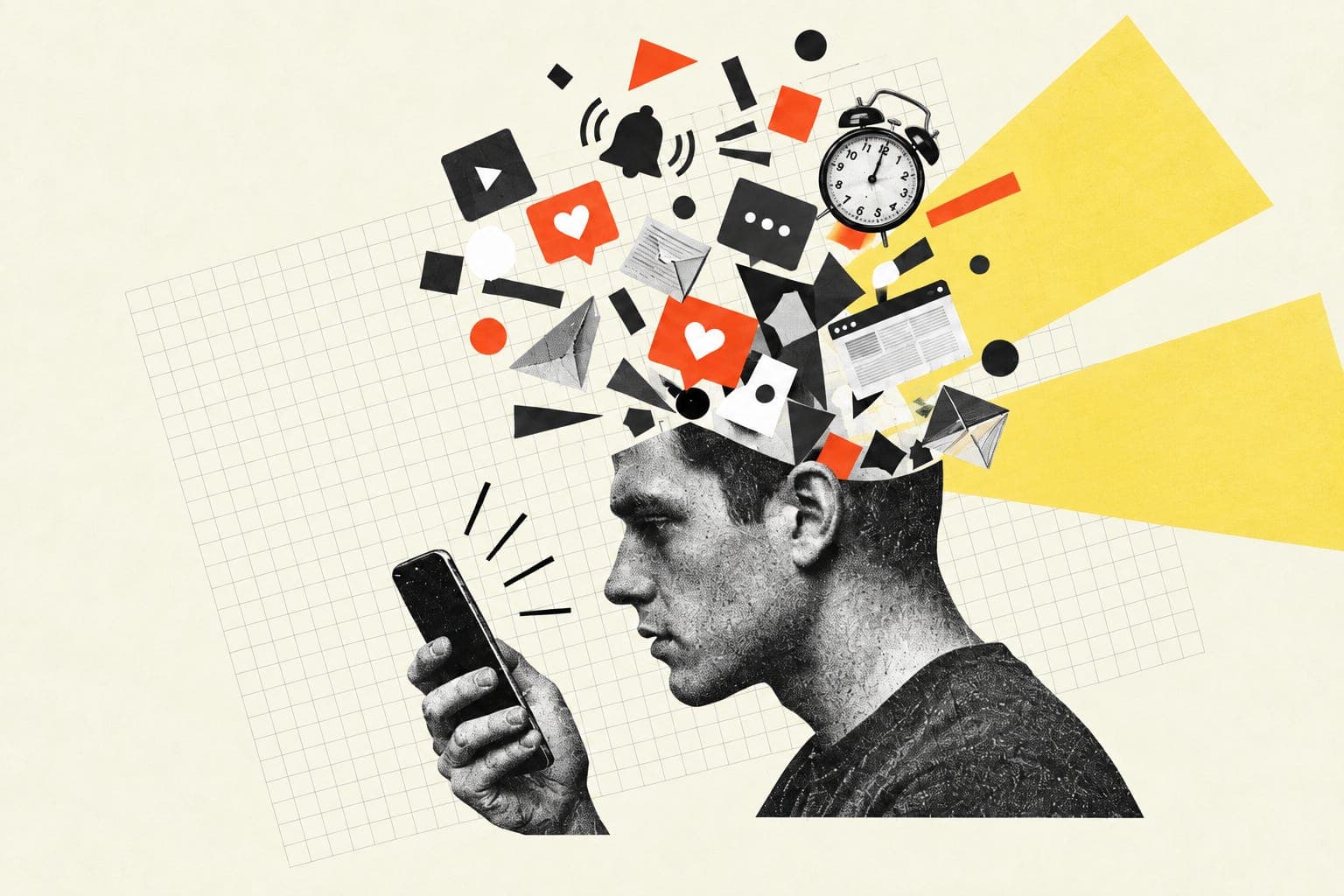
As the opening scene unfolds, you feel your phone buzz against your hip. A few minutes later, it buzzes again – twice this time. After the fourth buzz, you give in and turn your attention to the device, unlocking the screen to peer at the notifications waiting there. Before you know it, you’re absentmindedly scrolling with one eye on your Instagram feed and the other on the TV.
Towards the end of the episode, you feel a nudge from your partner as they mutter “oh my god” under their breath, and you glance up to realize you missed the scene that elicited that reaction. You were too distracted by your phone and your meal. You tell yourself you’ll rewatch it later, to fill in the gaps you missed.
This is more common than you might think. So common, in fact, that streaming giants like Netflix are (reportedly) simplifying the scripts and storylines of their shows to accommodate viewers’ tendencies to split their attention between the TV and their phone or another device. Back in 2025, The Guardian published an article to this effect, aptly titled, “Not second screen enough’: is Netflix deliberately dumbing down TV so people can watch while scrolling?”
It’s an odd, insidious impulse when you really think about it. You could be watching something genuinely good, but within ten minutes, you feel your traitorous hand reach for your phone. Not because you were bored. Just because we’ve all become, more or less, hardwired to scratch that ever-present, ambient itch. Sometimes, you might even catch it mid-motion and think: What am I doing?
Now, here’s the part you might not want to hear…
That reflex didn’t come from nowhere. You trained it. We all did, mostly without meaning to. Or, at least, the algorithm did.
You are training your attention every single day, whether you know it or not. And if you actually looked at where your attention goes (much like you would examine a training plan you complete in the gym), you might be horrified at what you’re subconsciously teaching yourself. But your ever-obliging brain treats whatever plan it’s given (conscious or not) as instruction.
So, if you spend your day shifting focus every few seconds from notifications to tabs, incoming texts, your inbox, Slack or Teams, and swiping past posts as if Instagram were a digital slot machine, your brain reasonably concludes, “this is what we’re doing now.” And then it starts optimizing for the thing you keep practicing.
The tragedy is that most of us are practicing distraction with a subconscious discipline that rivals the conscious discipline of a professional athlete.
Wandering minds in the algorithm era
The research on this increasingly spells a cautionary tale. A growing body of work reviewing short-form video use between 2019 and 2025 links heavy consumption to shorter sustained attention, poorer academic performance, and in some cases, differences in the white matter tied to behavioral control. This creates an effect that researchers have coined, only half-jokingly, “TikTok brain.”
Similarly, a 2025 systematic review described this shift in attention control through the lens of cognitive load, noting that the speed and density of content has outrun the brain’s ability to chunk and integrate what it’s taking in. As a result, information gets encoded shallowly and forgotten fast.
In a world that is practically drowning in competing inputs, we dull the instinct to swim to the surface. And as we become increasingly addicted to that “quick hit” effect of cheap, ever-accessible dopamine, the attention-erosion training loop is only intensified further. We sink deeper into the depths of perpetual distraction.
The underlying cost of all this is that the things that demand your full attention, like the shows and books and ideas with some hypothetical meat on their bones, start to feel like too much work.
There’s a cost to skipping the hard part
We didn’t end up here entirely on our own; it was by design.
As convenience-driven technology continues to descend upon the masses with sleek promises of a more streamlined and frictionless existence, the temptation to go straight from point A to B with little to no heavy lifting is strong – if not overwhelming.
And truth be told, sometimes that’s exactly the right call. Not every task demands (or deserves) for you to take the scenic route.
But everything I talk about with the athletes I coach is about the process. And here is what I know to be true: if you eliminate the process (if it’s viewed only as a means to an end) you lose every controllable piece of the experience. Every rep that was actually teaching you something.
Sometimes the process is the whole point.
The discomfort, the false starts, the bad first drafts, the uncomfortable block you have to think your way through: that friction isn’t a waste. Friction is the key ingredient for most of the the things that make a life truly feel like yours. And if you skip that process too many times, you might end up with the output and none of the person it was meant to build.
Attention is the raw material for all of it. And it’s far more trainable than we tend to believe.
Why you can’t just will yourself into thinking clearly
When you’re under serious load – too much stress, too much stimulation, too much cognitive noise – parts of your brain literally go offline.
I don’t mean this metaphorically. Your internal threat-detection system takes priority and starts rationing resources, and the higher-order regions responsible for creative, flexible, connect-the-dots thinking get deprioritized. This is why your best ideas rarely arrive when you’re over-stimulated, over-caffeinated, under-slept, and staring at 14 tabs under fluorescent office lighting with deadlines looming.
Instead, the better ideas tend to show up when you’re on a walk, in the shower, on a drive – when you finally stopped signalling threat to your own nervous system long enough for those key circuits to come back online.
Before you even ask, no – you can’t will this to happen. The relevant parts of your brain are literally getting less resource because of the state you’re in. It has nothing to do with how smart or capable you are, or how much willpower you have. Give yourself a lower-threat environment (a walk, some sunlight, and a few quiet minutes), and you can restore access to the exact machinery good thinking depends on.
As for the counter-attention-erosion tools we have at our disposal, meditation is one of the most reliable ways to practice that shift on purpose. According to a study led by Harvard-affiliated researchers, participating in an eight-week mindfulness meditation practice can make measurable changes in brain regions associated with memory, sense of self, empathy, and stress.
Translation: you’re retraining your internal alarm system.
The dose question: how much do you actually need?
I understand, and can certainly sympathize with the standard objections to starting a meditation practice. And I promise you. I’ve heard them all:
“I can’t sit there and be uncomfortable for five minutes.”
“I’m not good at it.”
“I don’t have time for it.”
So let’s talk about the dose honestly, because the minimal effective dose is actually much less than most people expect.
According to Center for Healthy Minds research, just five minutes of meditation a day is associated with a 28% drop in stress, 24% in depression, 18% in anxiety, and a 13% rise in social connection.
It’s also worth noting that consistency matters far more than volume or intensity. Little and often beats a lot but rarely every time. Sara Lazar, the Harvard neuroscientist behind much of the gray-matter research I referenced above, puts it in terms any athlete would recognize: three good sessions a week is great, but if all you can manage is a little bit every day, that’s genuinely a good thing too.
Once you’ve got the consistency piece nailed down, more hours, stacked over time, produce more structural and functional change. In other words, that five-minute daily habit offers an accumulative effect that might genuinely rewire your brain and change your life.
And if you push your way into the coveted realm of extended practice, things like full-day meditations or dedicated retreats appear to do something categorically different than the daily minimum. In serious meditation circles, it’s close to a rule that teachers do at least one retreat a year, precisely because sustained immersion reaches something the five-minute reps can’t touch.
Your regulation (or lack thereof) isn’t just about you
It’s important to remember that the state of your nervous system doesn’t stay politely contained inside you. It’s entirely contagious, and prone to bubbling over whether you mean for that to happen or not.
This is the science of co-regulation (grounded in polyvagal theory), and it’s why a genuinely calm adult can settle a dysregulated child in a way no amount of sheer reasoning can. Basically, kids borrow a regulated adult’s nervous system until they can build their own. But it doesn’t stop at children; your team, your partner, your friends, and the room in general can all read your state.
For example, when the Center for Healthy Minds ran its meditation program with more than 660 Wisconsin school employees, the teachers who received it reported lower distress and, notably, lower loneliness. The reason this matters for students? The quality of teacher–student relationships is among the strongest predictors of how kids actually do, and distressed teachers tend to have worse ones. Said another way: the most powerful intervention in a classroom is the regulated nervous system of the teacher.
Swap “classroom” for “company,” or “family,” or “marriage,” and the philosophy still holds. The most powerful intervention in the room is the regulated nervous system of the person everyone else is unconsciously calibrating to. Which means the five minutes you spend training your attention and turning down your own internal alarm system was never only about you. It also changes the weather for everyone standing within your orbit.
So, my advice to you is to audit the attention training plan you didn’t consciously write. Notice what you’re teaching your attention on any given day, and whether you’d sign off on it if someone handed it to you on paper. Then add one deliberate rep, like five minutes of reflection in an ocean of reception, and let it compound.
Because how you spend your attention, in the end, is how you spend your life. So, I think it’s worth being the one who decides how it’s spent.