
Everything you need to know about progressive overload (without overcomplicating it)
By Kosta Telegadas and Bryan Cummings, Coya Performance Coaches
You’re consistently showing up to the gym, putting in the work but the weight you’re moving hasn’t gone up in a couple of weeks. Does this mean you’ve made zero progress in the chase for increased strength and muscle?
Maybe, but not necessarily.
A lot of people assume that progressive overload is limited to just lifting heavier every session, and through that lens, it’s easy to get caught up in how much weight you’re lifting and expect that number to increase every workout.
And sure, adding weight is one way to measure improvement, but it is far from the only way.
The key is choosing an increase you can manage while maintaining good technique and recovering between workouts.
What Actually Counts as Progress?
Objectively:
More weight with the same reps and technique: Moving from 50 to 55 lb dumbbells with all else equal is a clear sign of a serious progression.
More reps with the same weight: Climbing to 10 reps from 8 reps using the same pair of load on any given movement.
More time under tension with the same weight: Slowing down your tempo, even if the weight and reps per set remain the same.
More sets or total work over time: Adding a working set to your normal allotment. Example: Performing 4 sets of one movement instead of 3.
Subjectively:
Better range of motion, control, or technique: Even if you use the same weight, reps and sets from one workout to the next, if you are able to slightly improve your reps from a control or technique standpoint, that is still meaningful progress and a good sign you’re ready to increase load safely.
Completing the same workout with less effort: If you can get through the entirety of your identical sets, reps and exercises from the last session but it feels much easier, that is another sign of adaptation and readiness to increase the challenge next time.
A Simple Example: When to Increase the Challenge
Let’s use a dumbbell bench press with a target of 8-10 reps x 3 sets.
Session 4: Increase to 55 lb dumbbells and return to 8 reps x 3 sets
Session 1: 8 reps x 3 sets with 50 lb dumbbells
Session 2: 9 reps x 3 sets with 50 lb dumbbells
Session 3: 10 reps x 3 sets with 50 lb dumbbells
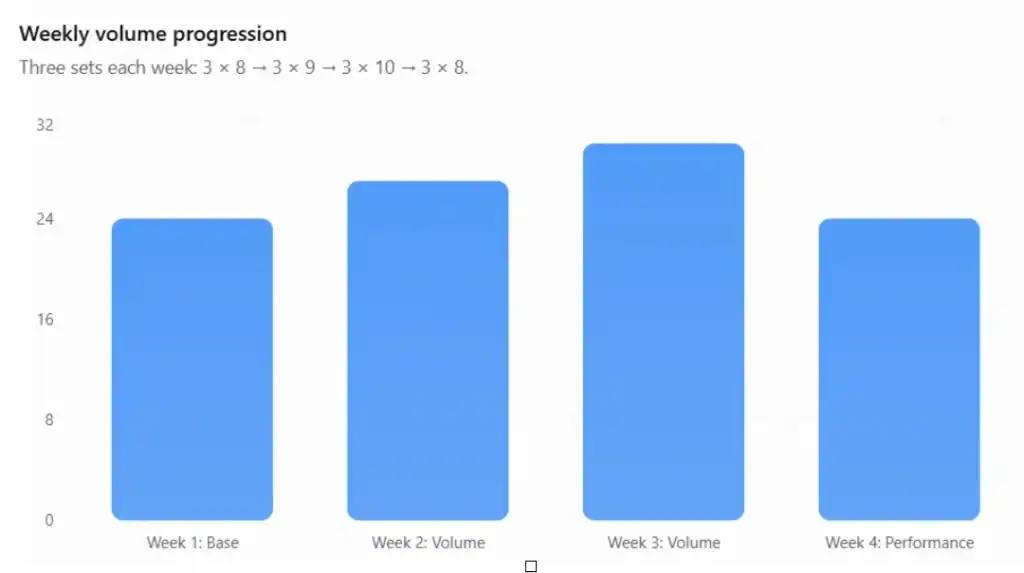
This is commonly referred to as a double progression model. You hit the top of the rep range with one weight, then increase the weight appropriately and start back at the bottom of the range.
This is an example, not a required script to follow session to session. You might need several workouts to add a rep, and your sets won’t always improve together. Going from 10, 9, and 8 reps to 10, 9, and 9 reps or 11, 9 and 8 reps is still progress.
Progress is not going to be linear day to day or week to week.
If the next weight is too heavy to execute your rep range with good technique, use a smaller increase if available or stay at the current weight longer with a wider rep range like 8-12 before raising weight again.
Example: After increasing biceps curls with 20 lb dumbbells from 10 to 12 reps, moving to 25 lbs might still be too much of a jump. Try extending the rep range to 10-15 instead. Once you hit 15 reps with the 20 lb dumbbells, 25 lb for 10 reps might be appropriate.
Effort absolutely matters, but the goal is to keep the reps consistent and standardized. If increasing weight means cutting the movement short or relying on momentum to survive every rep, stick with the previous weight a little longer before chasing more weight.
Extra sets work the same way. Constantly adding more sets just to finish your session completely can actually work against you, especially if it prevents you from recovering before your next session. You should leave knowing you worked hard but can recover well enough to keep making progress.
You can eventually move onto mixed double progression models and more advanced techniques, but there is a lot of runway for progress with the simple layout above.
What to Do When Recovery Is Poor
Some people ask us, “Hey coach what about recovery?”
Look, we’ve all been there. A hard session is a hard session. But some days, poor sleep, soreness, or stress make everything feel even harder. Before deciding how much to do, give yourself a ten-minute warm-up with some easy cardio, mobility, and a few lighter sets. If jumping is comfortable and already part of your routine, add a few low-effort hops or skips.
Then check in with yourself, and be honest: Are you feeling more ready to train, or does everything still feel like an absolute grind?
We wrote about recovery sessions in a recent Substack here.
How to Track Progress Without Overcomplicating It
Tracking is valuable, but it should never feel like a second job (nor should it extend your rest periods well beyond what you actually need). A notebook or a simple note on your phone is enough. Record the exercise, weight, sets, and repetitions, then add a short comment about how the movement felt.
References
Haff, G. G., & Triplett, N. T. (Eds.). (2016). Essentials of strength training and conditioning (4th ed.). Human Kinetics.