
“I don’t feel like you can show up as the best husband, father, and boss if you don’t show up every day healthy.” – Ryan Wall
Ryan brought the Coya Method to Silicon Valley Mechanical because he’d noticed something true and uncomfortable: the people responsible for the health of the business were often left neglecting their own.
So he asked his executive team a simple question: how would you feel about doing this together? He framed it as a bonding opportunity that would not only bring the team closer together, but would empower each member of his team (on an individual level) to take charge of their health.
The answer, unanimously, was yes.
Pre-Coya Reality
This wasn’t a group that needed to be convinced that health mattered. These are high-performing executives, several with dozens of direct reports, who already understood the stakes in theory. But as Ryan put it, health has a way of taking a backseat as the demands of running a company pile up. Too many executives end up sacrificing their health with the justification that they will make up for it later. In some cases, it isn’t a conscious decision at all. It just happens, mentally and physically, until that erosion becomes impossible to ignore.
“When Ryan first raised the idea, there wasn’t a moment of hesitation. It sounded amazing,” shared one executive on the team. Another described it as team bonding wrapped around something bigger – the opportunity to get into better shape, sure, but also to understand what actually makes them all tick. The whole group was bought in before the first session even hit their calendars.
The Experience
What surprised the team most was how little the program asked them to overhaul. “It’s not like a big program that you’re having to adjust your life to,” one executive said. “It’s more of a layer that you’re putting on to help your life be more manageable.” For a group whose calendars were already full, this was huge. The information landed because it was palatable. Specific enough to be useful, but simple enough to be actionable and sustainable.
One team member pointed to the individual coaching sessions as the moment where the concepts really started to click. Learning nutrition principles in the abstract is one thing; sitting down with a coach who pulls up your actual calendar and says, here’s where you’re getting 20 grams of protein, here’s where this fits into your day, is another. That kind of specificity – built around a real person, their goals, and the reality of their schedule – was what made the habits stick instead of sliding off after week one.
And then there was the format itself. Coya’s cohort model turned out to be one of the most valuable parts of the experience, not because of competition, but because of exposure. In the group’s regular meetings and in the ongoing chat thread, executives could see what their colleagues were experimenting with – everything from a new sleep routine to a tweak to their training – and borrow it. “If I was doing it alone, it would be a lot harder,” one executive said. Doing it as a team removed the isolation that usually kills a health habit before it becomes a routine.
The Ripple Effect
Whenever we work with individuals or teams, there is usually a “ripple effect” that occurs. An individual transformation that extends beyond that person to influence the people around them, too.
At SVM, we had an executive go through the program with his spouse, and the two of them found that doing it together made the whole thing exponentially more effective. Rather than comparing just notes on their individual journeys, they were two people actively working on the same things in real time. Restorative sleep percentage became a normal part of dinner conversation. It stopped being “my health project” and became something they were building together.
That’s the pattern across the group: what started as an executive initiative didn’t stay confined to the C-suite. It moved into how these leaders think about their teams, their families, and as Ryan put it, the culture of the company itself. “That executive group is responsible for dozens of people,” Ryan said. “Having them be healthy mentally and physically makes everybody on their team perform a little better.” The plan now is to bring the program to the broader company, not just the leadership layer.
The Results
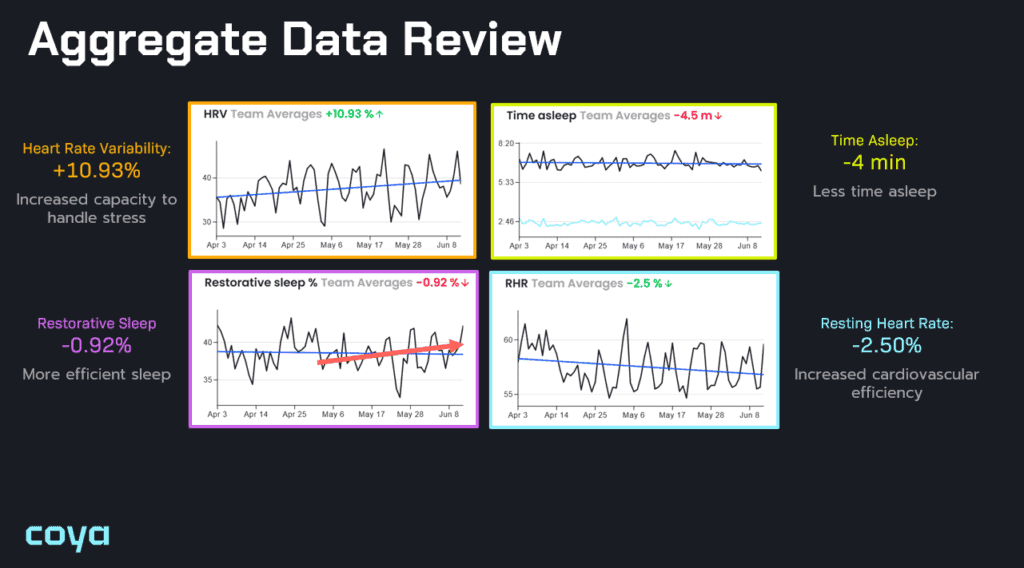
Beyond the numbers, the team noticed a significant shift in how they show up for each other, for their families, and for the people who report to them. As one executive said, this is yet another example of how the company operates: not just watching a bottom line, but making sure everybody is doing well and that, in his words, “the tide is all rising together.”
Post-Cohort Takeaway
Ryan set out to build a healthier executive team. What he actually created was a shared language that a group of high performers could use to be honest about what’s working and what isn’t, and to bring what they learned to every area of their life and the people who matter most to them. As the company prepares to extend the program company-wide, Silicon Valley Mechanical’s leadership team is proof of something Coya sees again and again: health habits are far more durable when they’re built inside a community, not in isolation.
“We’ve provided a culture and an environment here that allows for people to be healthy,” Ryan said. “That’s why I brought Coya into the office.”